
2026-08-27 · Danny Alvarez
Building for Salt Air and Hurricane Season: Materials and Timing Choices That Protect a Palm Beach Storefront
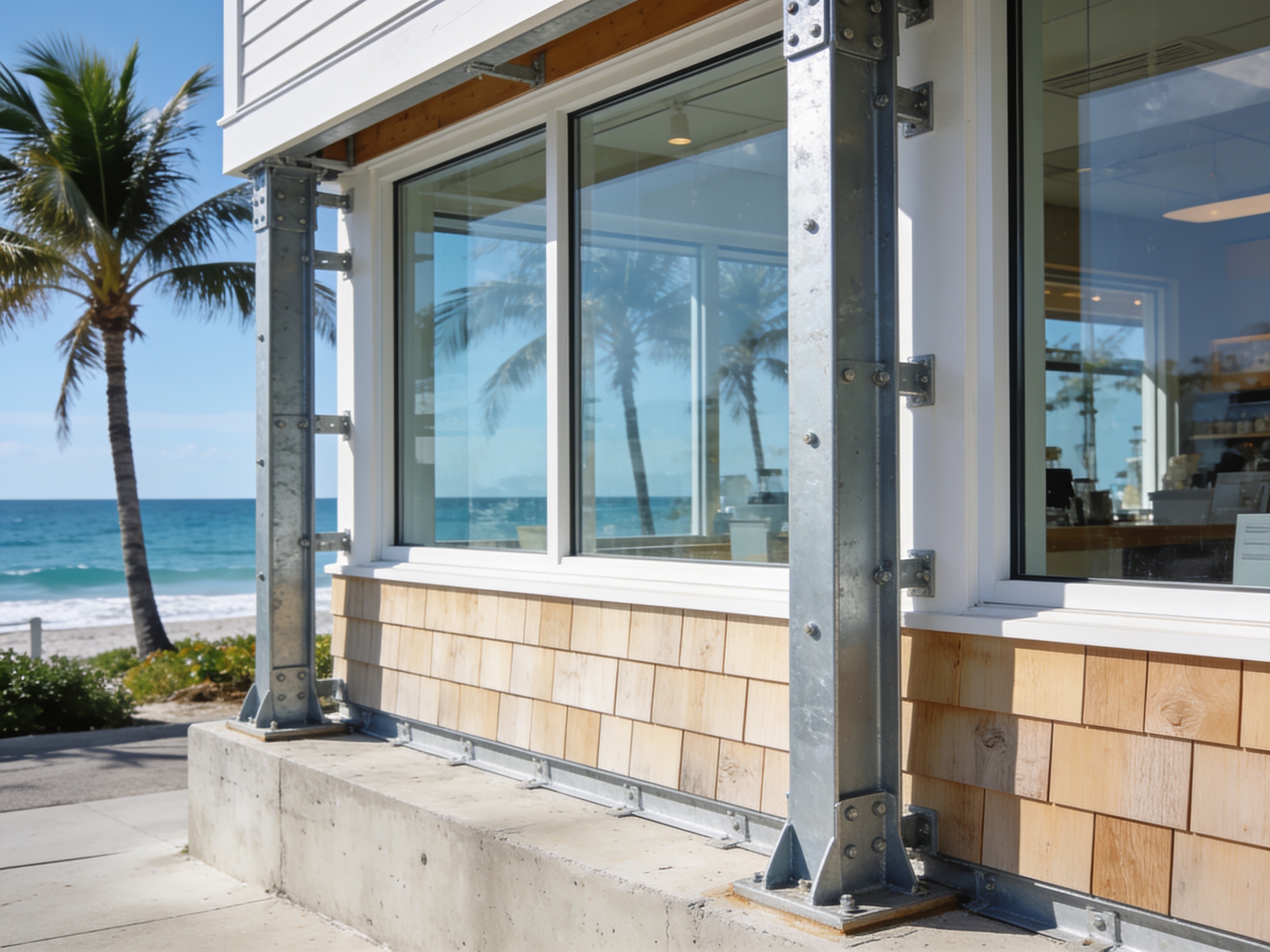
If you're building out a storefront in Palm Beach, the two decisions that protect your investment most are metal selection (316 stainless, marine-grade anodized or thermally broken aluminum instead of plain steel or standard-grade fasteners) and build timing (finishing exterior work before the June 1 start of hurricane season and avoiding permit submittals during the busiest storm months). Salt-laden air off the Atlantic pits ordinary hardware within 12–24 months on an oceanfront South End or North End frontage, while impact-rated glazing and properly detailed sealant joints routinely last 15–20 years. Get those two calls right and you spend on merchandising instead of rust repairs.
Why Salt Air Is Harsher Here Than Two Miles Inland
The barrier island geography matters. A storefront on Worth Avenue or along South Ocean Boulevard sits within a few hundred yards of breaking surf, and the prevailing easterly sea breeze carries chloride mist inland every day of the year. Compare that to a tenant space in Lake Worth or Riviera Beach, only a short drive west, where the same door hardware might last twice as long. The tropical climate compounds it: hot, humid summers keep surfaces damp for long stretches, and moisture plus chloride is what actually drives corrosion — not salt alone.
What that means practically on a Palm Beach job:
- Fasteners should be 316 stainless, not 304 and never zinc-plated. The price difference on a storefront's worth of screws and anchors is usually $150–$600 — trivial against a door frame replacement.
- Aluminum storefront systems need a marine-grade anodized or high-performance fluoropolymer finish. Standard painted aluminum chalks and streaks within a few seasons of direct exposure.
- Rooftop and exterior HVAC condensers benefit from coastal coil coatings; uncoated coils near the ocean can lose efficiency and fail years early.
- Steel lintels and hidden structure in older masonry buildings are the silent problem — see below.
The Age of the Building Changes the Job
Much of the commercial stock in the Worth Avenue District and Midtown is decades old — masonry and stucco with Mediterranean Revival detailing, some of it dating from the 1920s and 1930s era that defines the streetscape near Palm Beach Town Hall and the Society of the Four Arts. When you open a wall on one of these buildings, expect surprises: original steel lintels that have rusted and expanded, cracking the stucco above the opening; sealant joints that were last redone a generation ago; and framing that never anticipated modern impact-glazing weights.
Budget for that. On older frontages, allow a contingency for lintel repair or replacement and stucco patching once demolition exposes the reality. We plan discovery openings early — during permitting, not after finishes are ordered — so the number lands in the budget rather than as a change order. If you're pricing a project from scratch, the line-item cost breakdown for a Palm Beach County build out walks through where these allowances belong. Newer shells in the North End and South End are simpler structurally, but often have tighter HOA and architectural review conditions that shape what the facade is allowed to look like.
Glazing, Doors and the Impact Requirement
Storefront glass is where hurricane protection and merchandising collide. Two compliant paths exist: impact-rated laminated glazing in a tested frame, or standard glazing with approved shutters or panels. For retail, laminated impact glass almost always wins — the storefront stays open and visible, there's no labor scramble to install panels before a storm, and insurers generally prefer it. Expect impact-rated storefront systems to run meaningfully more per square foot than non-rated aluminum and glass, and expect lead times measured in weeks, not days.
A few details that separate a storefront that lasts from one that leaks:
- Verify the product approval covers your exact configuration — width, height and design pressure — not just the product family.
- Insist on a sill pan and end dams at every door and window opening. Wind-driven rain in a tropical downpour finds any gap in the sill.
- Use a high-movement silicone sealant at perimeter joints, tooled properly, not a cheap acrylic caulk that fails in 3–5 years.
- Isolate dissimilar metals. Aluminum in direct contact with steel or masonry anchors corrodes galvanically; a nylon isolator or coating prevents it.
This level of detailing is the core of any storefront and facade renovation done properly on the island.
Timing the Schedule Around Hurricane Season
Hurricane season runs June 1 through November 30, and the practical peak for our stretch of the Palm Beach coast is August through October. Building season here is essentially inverted from the rest of the country: the smart sequence is to submit permits in late summer, do demolition and interior rough-in through fall, and complete exterior envelope work — glazing, roofing penetrations, facade sealants — between December and May, when rain events are shorter and humidity is lower for coatings and adhesives to cure properly.
That calendar also respects the retail reality. Season on the island runs roughly from Thanksgiving through Easter, when The Breakers is full, Worth Avenue is busy and traffic near Mar-a-Lago backs up. Landlords in the Worth Avenue District often restrict noisy or street-blocking work during those months, so exterior work sometimes has to happen in narrow windows with early-morning start times. Permit review adds its own lead time — our guide to permits, reviews and timelines for a tenant build out covers what to expect across Palm Beach and West Palm Beach jurisdictions.
What to Do If You're Mid-Construction When a Storm Forms
Every project on the island needs a written storm plan before the first opening is cut. When a system enters the forecast cone, you generally have 48–72 hours of usable working time:
- Dry-in any open opening with plywood or approved temporary panels; don't rely on plastic sheeting.
- Remove or secure all loose material, scaffold planks and signage — they become projectiles.
- Photograph the site for insurance and lower any hoisted material to the ground.
- Protect interior finishes already installed; a flooded slab can cost weeks of drying.
Building conservatively from the start reduces how much of this you ever have to do. If you're planning a retail build out on the island, bring material and schedule decisions into the same conversation early — they're the same decision. We're reachable Monday through Friday, 8am–5pm, and Saturday mornings 8am–12pm to walk a space and talk through what the building in front of you actually needs.